

Employer Branding in 2026: The Complete Guide to Employer Brand Visibility
Whether you’re refining an existing strategy or figuring out how to stay consistent with limited resources, this guide is built to help you make your employer brand visible to the candidates you want to attract.
Employer branding defines what it’s like to work at your company. Employer brand visibility ensures that candidates actually see those stories across social media, career sites, and employee networks.
What is employer branding? (quick summary)
Employer branding is how a company is perceived as a place to work by candidates, employees, and former employees. It is shaped by employee experiences, company culture, reputation, and how those stories are shared publicly across platforms like social media, career sites, and employer review platforms.
Employer branding helps companies:
- Attract better-fit candidates
- Reduce time-to-hire
- Improve offer acceptance rates
- Strengthen employee retention
- Reduce reliance on paid recruiting channels
Employer branding defines the story. Employer brand visibility ensures candidates actually see it.
What employer branding actually is (and what it isn’t)
Let’s clear something up: employer branding is not the same as recruitment marketing, and it’s also not just posting a “we’re hiring” graphic on Instagram every few weeks.
Employer branding is how your company is perceived as a workplace, by candidates who’ve never met you and by employees who show up every day. It lives in your social content, your career site, your job descriptions, your Glassdoor reviews, your interview experience, and the things your team says (or doesn’t say) when someone asks “so, what’s it like to work there?”
You’ve probably heard the saying that your employer brand exists whether you manage it or not. And it’s true. Right now, candidates are Googling your company, scrolling your LinkedIn page, reading Glassdoor reviews from two years ago, and making up their minds before they ever click “Apply.”
The question isn’t whether you have an employer brand. The question is whether the picture candidates are seeing actually reflects what makes your company a great place to work—and whether they’re seeing it often enough to form a real connection.
This guide covers everything you need to know: what employer branding really means, how to build it, how to promote it consistently, how to measure whether it’s working, and which tools (including HireSocial by CareerArc) make the whole thing a lot more manageable. We’ll also look at real companies doing it well and answer the questions we hear most often.
Every organization already has an employer brand. What matters is whether the picture candidates are forming reflects your actual strengths—and whether they’re seeing it often enough to trust it. It’s shaped by what your people post, how your leaders show up online, and how consistently you communicate your values externally. Every touchpoint adds a brushstroke to the picture.
Most companies invest heavily in their consumer brand and treat employer branding as an afterthought. But the candidates you’re trying to hire are another kind of “customer,” and they’re paying attention, too. A company that looks exciting from the outside but has nothing to say about its culture is a red flag to a savvy jobseeker.
Employer branding is all about giving candidates an accurate, compelling, and consistent view of what it’s genuinely like to work at your company—and doing that often enough to actually register.
Why employer branding matters more than you think
According to CareerArc’s own employer branding research, 62% of job seekers visit social media channels to evaluate an employer’s brand before deciding whether to apply. They’re not waiting for your job posting to find out who you are. They’re already forming opinions with or without your input, and those opinions matter at every stage of the hiring process, not just the top of the funnel.
Here are a few of the benefits of investing in your employer branding presence:
Attract better-fit candidates
When candidates understand your values, culture, and what day-to-day life actually looks like at your company, they self-select more accurately. The people who apply are more likely to be genuinely excited about what you offer—and less likely to bounce three months in because it wasn’t what they expected.
Shorten the hiring process
Familiarity breeds trust, and trust speeds things up. When a candidate already has a positive impression of your company, they move through the process faster and are more likely to say yes to an offer. You’re not starting from zero every time you open a new role.
Reduce reliance on paid channels
Job boards are expensive. A consistent employer brand presence creates long-term interest that doesn’t disappear the moment you stop paying for it. Think of it like compounding interest: steady investment now pays off significantly over time.
Support retention
Employer branding doesn’t stop mattering once someone is hired. Employees who felt confident in your culture before they joined are more likely to stay, and employees who feel proud of where they work are more likely to become advocates—sharing your content, referring friends, and reinforcing the brand you’ve worked hard to build. Then, the cycle continues!
Protect yourself when the market shifts
Hiring needs ebb and flow. Companies that have consistently invested in their employer brand have a built-in audience of warm candidates already familiar with who they are. When you need to scale quickly, that’s an enormous advantage over starting from scratch.
The business case: Long-term value backed by real data
Employer branding directly impacts hiring outcomes. Research shows that:
- 82% of candidates consider employer brand and reputation before applying (CareerArc)
- 53% of job seekers research companies after reading a job posting (Glassdoor)
- 72% of recruiting leaders say employer brand significantly impacts hiring (LinkedIn)
If you need to make the internal case for employer branding investment, the numbers are squarely in your corner. Here are three that cut straight to the point.
First: 82% of candidates consider employer brand and reputation before applying to a job [Source: CareerArc 2024 Employer Branding Survey]. Not some candidates—82% of them. That means your brand is actively shaping who applies (and who doesn’t) before a single recruiter conversation happens.
The more you can influence those candidates in a positive direction, the better hires you’ll sign on.
Second: even the candidates who do find your job posting aren’t stopping there. 53% of job seekers look for more company information after reading a job post [Glassdoor]. They go looking for your social presence, your reviews, your employees’ LinkedIn profiles, your leadership’s posts. What they find—or don’t find—is what determines whether they move forward.
A strong employer brand makes that research work in your favor, while a weak or invisible one may lose candidates who were already interested.
Third: your competitors are already doing it. 72% of recruiting leaders worldwide agree that employer brand has a significant impact on hiring [LinkedIn]. The talent attraction professionals closest to the hiring process—the people whose jobs depend on filling roles efficiently—are in broad agreement that your employer brand matters.
If you ignore yours, you might lose candidates to other teams that have made employer branding a priority.
How to build your employer brand: A 5-step process
If you’re starting from scratch—or feel like you have a shaky employer brand but haven’t really defined it—here’s a clear framework to get grounded.
Step 1: Listen before you speak
Before you create a single piece of content or draft a line of messaging, spend time gathering honest input from the inside. Employee surveys, exit interviews, internal feedback channels, and even recurring themes in performance reviews can tell you a lot about what your culture actually looks and feels like—not just what leadership hopes it feels like.
Look for patterns: What do people consistently say they love? What do people bring up when they’re frustrated? What made employees who left decide to go? This raw material is genuinely valuable, and it’s freely available to you. Even a simple anonymous Google Form can help you gather it!
The goal is to understand the real employee experience, including the parts that could use work.
Step 2: Identify what makes you distinct
Every company says they offer “a collaborative environment” and “opportunities for growth.” Those phrases have been used so many times they’ve stopped meaning anything. The question is what makes your company different in ways that actually matter to the specific people you’re trying to hire.
Maybe it’s unusual career trajectory opportunities—paths that don’t exist at larger companies. Maybe it’s genuine flexibility with no performance penalty. Maybe it’s a mission that a particular kind of person finds deeply meaningful. Maybe it’s the kind of team culture that makes people stay for years.
Whatever it is, find it, name it specifically, and anchor your brand messaging to it.
Step 3: Define your employee value proposition (EVP)
Your EVP is the core promise your company makes to employees: the summary of what you offer and why it’s worth their time. It’s not the same as your mission statement or your consumer brand tagline. It’s specifically about the employment experience.
A strong EVP answers: “Why should someone choose to build their career here?” The insights from Step 2 will be helpful here—lean on those benefits!
Once you’ve defined it, your EVP becomes the north star for all your employer brand content: job descriptions, social posts, career site copy, and how your team talks about the company in interviews.
Step 4: Find the stories that bring it to life
An EVP on a slide deck is invisible, but real stories are what make it tangible. Look for moments and experiences that illustrate your values in action: the team that rallied to solve a hard problem, the employee who grew from intern to manager, the benefits that made a real difference when someone needed them most, or the manager who changed how someone thinks about their career.
These stories exist, but you may have to go looking for them. Employee spotlights, team interviews, behind-the-scenes content, and even informal conversations on social media are all powerful ways to surface what makes your culture real and worth talking about.
Step 5: Start sharing (without waiting for perfect)
Finally, here’s the permission slip you might need: you don’t have to wait for a finished brand book, a fully approved content calendar, or the perfect visual identity before you start sharing. You can start right now with the stories, values, and moments your team is already proud of.
Consistency matters more than perfection. A steady stream of authentic, specific content will build trust with candidates over time in a way that a single polished campaign simply can’t. Start somewhere and build from there!
How to promote and distribute your employer brand consistently
Building your employer brand is step one. Actually getting it in front of candidates—repeatedly and in the right places—is where most companies fall short. Visibility is everything, and visibility requires showing up where your candidates already spend their time, and showing up often.
This process is often called employer brand distribution—ensuring that your culture, employee stories, and company values consistently reach potential candidates across social media, career sites, and employee networks.
Here are a few tips to make the most of your content.
Social media is your highest-leverage channel
Social media is one of the most efficient and cost-effective ways to share stories about your culture, your people, and the day-to-day experience of working at your company. And unlike job boards, it works even when you’re not actively hiring, building familiarity with your brand continuously over time.
LinkedIn is essential for most professional audiences. Instagram and Facebook can be powerful for culture content, especially visual storytelling. X (formerly Twitter) works well for companies in tech, media, or industries where candidates are already active there. You don’t need to prioritize every channel equally—just focus on being consistent on the platforms where your target candidates actually are. (Here’s a guide to what works best on each platform!)
Diversify your content mix
If there’s one thing you take away from this guide, it’s this: don’t just post job openings. That’s the recruiting equivalent of only talking to someone when you want something. A strong employer brand presence includes a variety of content types:
- Employee spotlights that highlight real people and their paths
- Team celebrations marking milestones, wins, and anniversaries
- Benefits previews that show what your company actually offers
- Culture content that gives a window into day-to-day life
- FAQs and myth-busting posts that answer candidate questions
- Behind-the-scenes content from events, projects, or the workplace itself
- Hiring manager intros so candidates can picture who they’d be working with
When you vary your content, you reach more people, stay interesting to return visitors, and paint a clearer picture of who you are as an employer.
Maintain a consistent visual and tonal identity
Consistency is what transforms individual posts into a recognizable employer brand. Use a consistent look—colors, fonts, photo style—across all platforms so your content is immediately identifiable even before someone sees your name.
The same applies to tone: if your culture is warm and a little funny, your content should be too. If you’re mission-driven and serious, let that come through authentically. (Pro tip: HireSocial by CareerArc can help on both fronts!)
Activate your internal advocates
Your employees are your most credible employer brand ambassadors, full stop. Content shared by real team members gets more engagement, reaches more people, and is trusted significantly more than content from a company page alone.
According to LinkedIn, while only 3% of employees share content about their company, those shares are responsible for driving a 30% increase in the total engagement a company sees. They also shared that companies with socially engaged employees are 58% more likely to attract top talent and 20% more likely to retain them [Source: LinkedIn 2023 Employee Advocacy Research].
That means equipping your recruiters, HR team, and enthusiastic employees with content they can share from their own profiles, tools that reduce friction, and enough context to know what’s appropriate to post.
Use automation to stay consistent
The number one reason employer brand content falls off is not budget or strategy. It’s consistency—specifically, the gap between a good intention and actually posting regularly over the course of weeks, months, or years.
Thankfully, that’s where automation comes in to save the day! With HireSocial by CareerArc, for example, you can select topics like culture, events, or benefits to get AI-generated posts ready for your final approval. (Unlike AI slop generated by many other tools, these are informed by existing marketing-approved content, and you’ll notice the quality difference!)
Then, posts get published according to your predetermined publishing cadence—each profile owner can set their own! It’s a great way to ensure high-quality content is going out whether you’re able to prioritize it day-to-day or not.
How to measure the impact of your employer brand
One of the main reasons employer branding efforts lose internal support is that teams fail to connect their work to measurable outcomes. The good news: there’s plenty to track. The key is choosing the right metrics for what you’re trying to prove.
Content performance metrics
Start with the basics: how is your content actually performing? Track engagement rate (likes, comments, shares), reach, click-throughs to your career site, and follower growth over time. These won’t tell the whole story, but they’ll tell you which types of content resonate and which fall flat so you can do more of what works.
Pay particular attention to comments over likes. A comment means someone felt something strongly enough to engage. That’s a much warmer signal than a passive double-tap.
Recruiting funnel metrics
- Application volume: Are more people applying over time? Are applications increasing from organic sources (social media, word of mouth) relative to paid?
- Time-to-fill: Are roles filling faster as brand awareness grows?
- Quality of hire: Are managers reporting better fit from recent hires? Are new employees staying longer?
- Offer acceptance rate: Are more candidates saying yes when you extend offers?
Tracking these metrics over time—especially in correlation with your employer brand investments—is how you build the internal case for continued resources.
Brand perception and reputation signals
Platforms like Glassdoor, Indeed, and LinkedIn give you ongoing feedback on how your company is perceived as an employer. Monitor your ratings, read the reviews, and look for patterns. Are there consistent complaints about specific aspects of the experience? Are recent reviews more positive than older ones?
Here’s a smart move many companies overlook: positive Glassdoor reviews can be repurposed as social content. A glowing employee review (with permission or properly attributed) is authentic social proof in a format candidates trust. HireSocial makes it easy to turn this kind of content into shareable posts without the awkward copy-paste job.
Organic vs. paid traffic
Track what percentage of your career site traffic and application volume comes from non-paid sources: organic search, direct visits, social referrals, and employee shares. As your employer brand strengthens, this number should grow. It’s one of the clearest indicators that you’re building something that works long-term rather than renting attention short-term.
Seeing lots of traffic that isn’t converting to applications? Take a look at your application process. If it’s too long, repetitive, or clunky on mobile devices, you might be driving candidates away.
Internal Signals
Finally, don’t overlook what’s happening inside the company. An increase in employee referrals is a strong signal that your team believes in the brand enough to put their name behind it. Improved scores on engagement surveys (especially around pride in the company and likelihood to recommend it as a place to work) are equally meaningful. These internal signals often move before the external metrics catch up.
Tools and resources that make it easier
Employer branding requires consistent effort over time, and consistency is a lot easier when you have the right tools supporting you. Here’s a breakdown of what’s worth having in your stack.
HireSocial by CareerArc: purpose-built for employer brand visibility
Once companies have defined their employer brand, the next challenge is distributing it consistently across channels and employee networks.
HireSocial is CareerArc’s employer brand platform, and it’s worth understanding what makes it different from just using a social media scheduler built for consumer marketing.
HireSocial’s AI-generated social content uses your existing assets like your job listings, career site copy, culture content, and brand materials. It creates posts that are already grounded in your brand voice and existing content, which means the output actually sounds like you. That distinction matters enormously for companies who’ve spent real effort defining what they stand for.
Here’s are just a few of the things HireSocial helps you do:
- AI-assisted content creation based on your job listings, culture content, and career site—so you’re not starting from a blank page, the source content is already public and therefore marketing-approved, and you don’t end up with AI slop!
- Multi-platform scheduling and publishing across LinkedIn, Instagram, Facebook, and X from one place
- Content organization by category—benefits, DEI, hiring events, culture—so you can maintain variety and easily see what’s resonating with candidates
- Employee and recruiter advocacy tools that allow your team to auto-publish content from their own profiles, expanding your reach through trusted, real voices with marketing-approved language
- Performance tracking so you can see what’s working and keep doing more of it
For teams with limited bandwidth—which is most teams!—HireSocial is specifically designed to keep employer brand content moving without requiring a dedicated social media manager for every post. It’s often the difference between “we try to post when we have time” and a real, consistent strategy.
Other tools worth having
Outside of HireSocial, there are a few other resources that may be helpful to build out your employer brand.
First, employee survey platforms (Culture Amp, Lattice, SurveyMonkey, or even Google Forms) can be helpful for gathering the internal feedback that should feed your employer brand strategy. The insights you get from regular pulse surveys are invaluable for understanding how your actual employee experience maps to what you’re promoting externally.
Next, employer review monitoring platforms (Glassdoor, Indeed, Comparably) are worth checking to stay on top of your reputation and surface both concerns to address and positive quotes worth promoting. Just make sure to set up alerts or calendar reminders so you’re not catching reviews three months late!
Finally, a simple content calendar (Notion, Airtable, or even a shared Google Sheet) is useful to plan content in advance and maintain variety across content types. Sophistication not required—whatever works for you is perfect!
Company examples: how real employer brands are showing up on social
The best way to understand what good employer branding looks like in practice is to see examples in action. These companies have all found ways to show up consistently, authentically, and in ways that make candidates want to learn more.
One thing most of these companies have in common: they don’t limit employer brand content to the company page. They activate real people like employees, recruiters, and hiring managers to share from their own profiles. That combination of company content and personal voices is what creates reach, trust, and staying power.
Avient
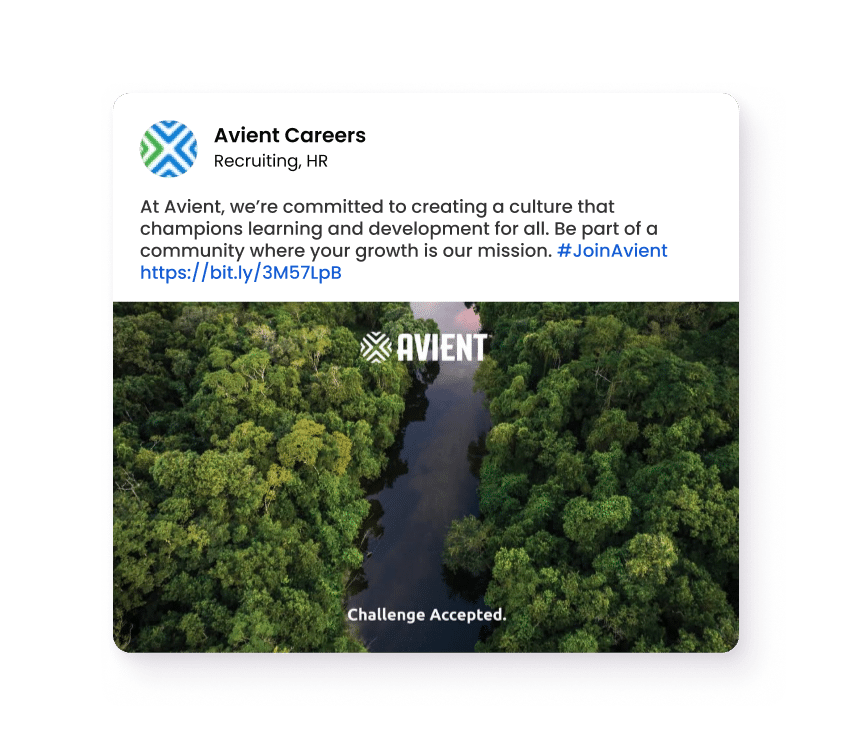
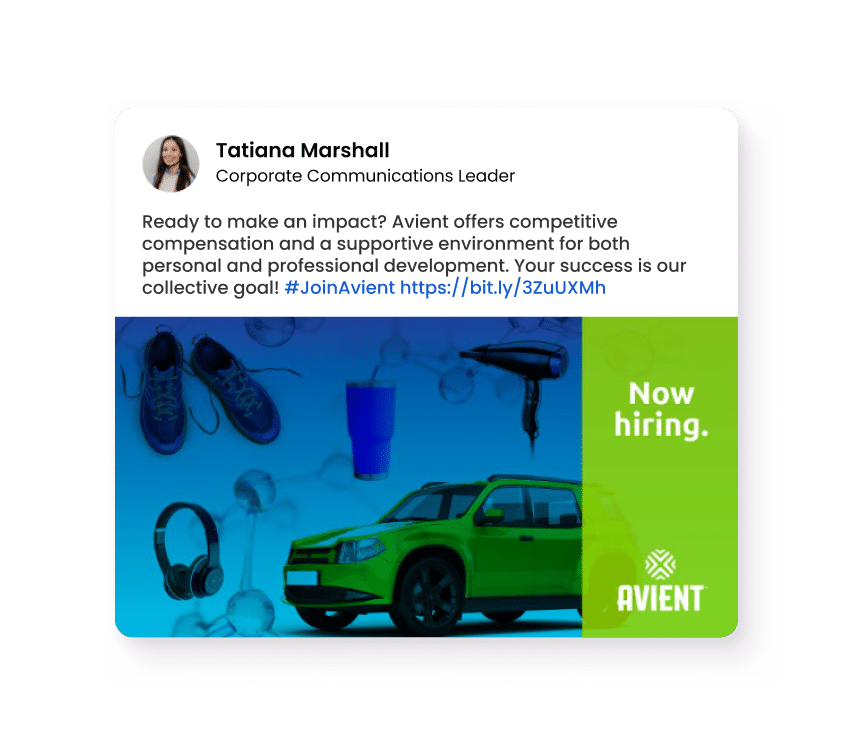
Avient is a great example of using company and employee profiles for a coordinated strategy. They leverage their company page as a place for candidates to explore, where they can learn more about the company’s culture and evaluate whether it may be a fit for their career goals. Employee and recruiter profiles then help their employer brand reach new audiences.
Company profile: Sustainability
Employee profile: Rewards + Benefits
YMCA of the Rockies
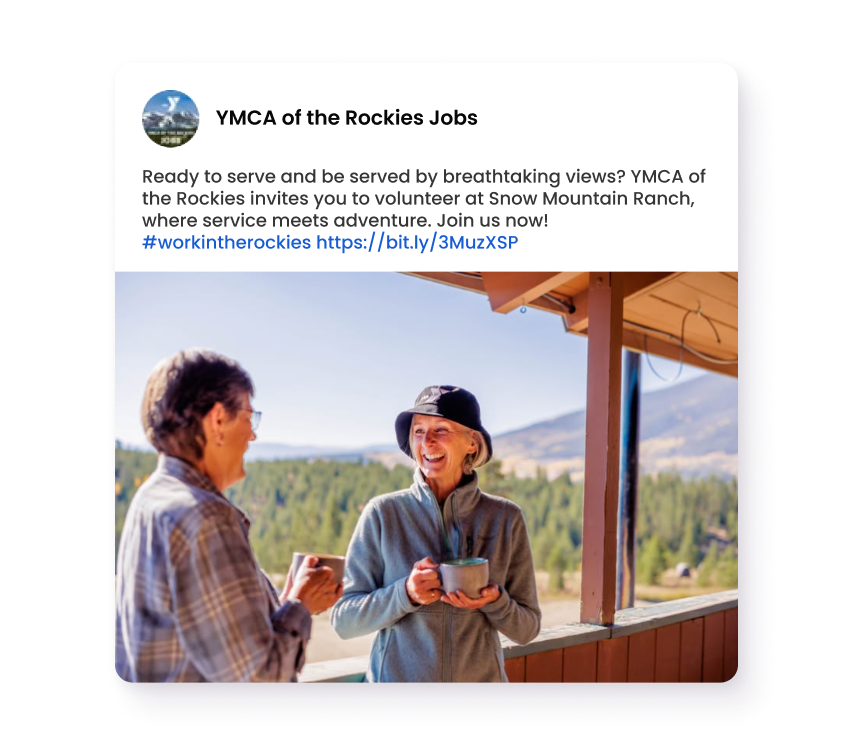
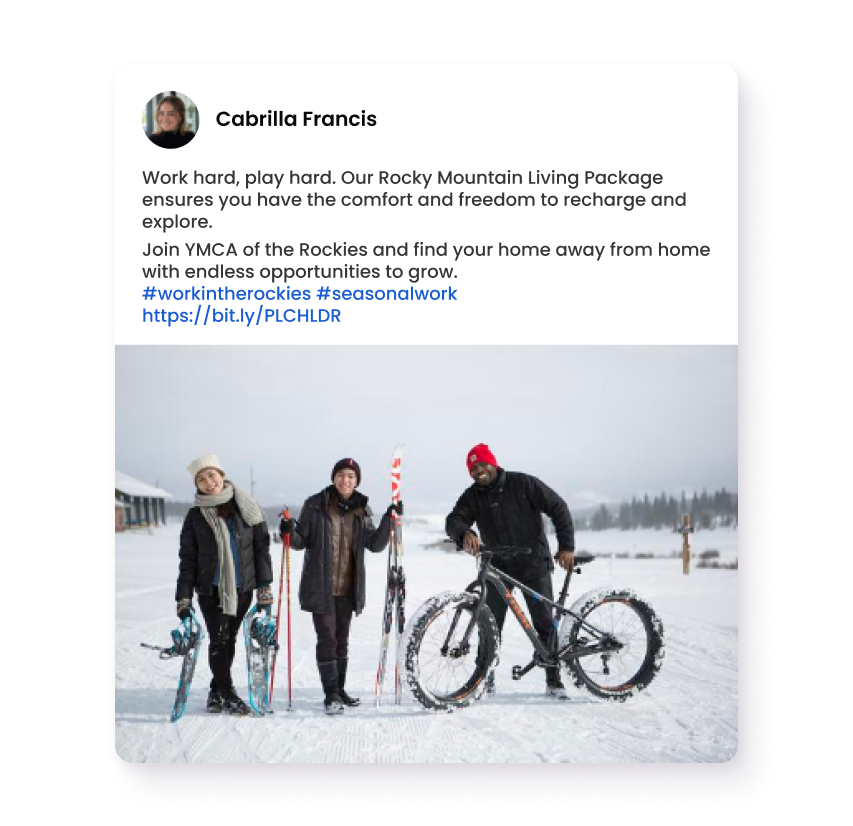
YMCA of the Rockies leans fully into what makes them unlike any other employer—a mountain lifestyle, a gap program, and work that feels like an adventure—and their content is specific enough to make exactly the right candidate stop scrolling.
Company profile: Volunteer program
Employee profile: YMCA culture
Mortenson Dental Partners
Mortenson Dental Partners uses both its company page and employee posts to share about team benefits and charitable foundation work, creating an employer brand that reads as both professionally secure and genuinely community-minded.
Company profile: Benefits
Employee profile: Charitable foundation
Mastercard
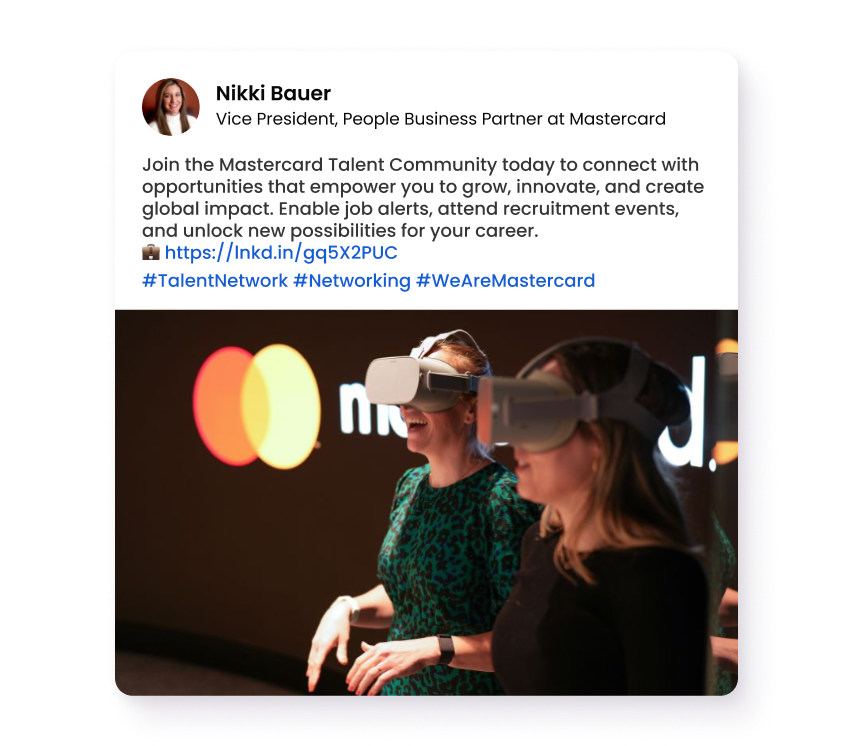
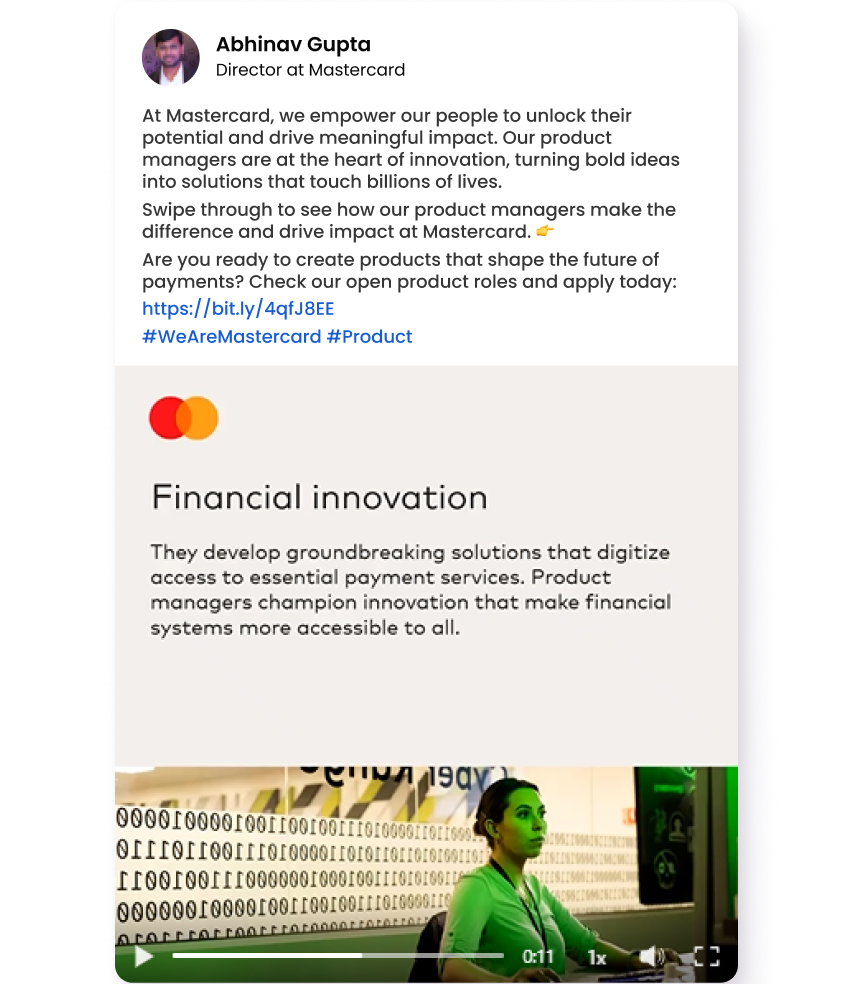
Mastercard’s strategy leans heavily on employee advocacy. Their people post about career growth, innovation impact, interview tips, and talent community sign-ups, reaching audiences and carrying credibility that a company page simply can’t match.
Employee profile: Talent community
Employee profile: Innovation + Impact
Agrace
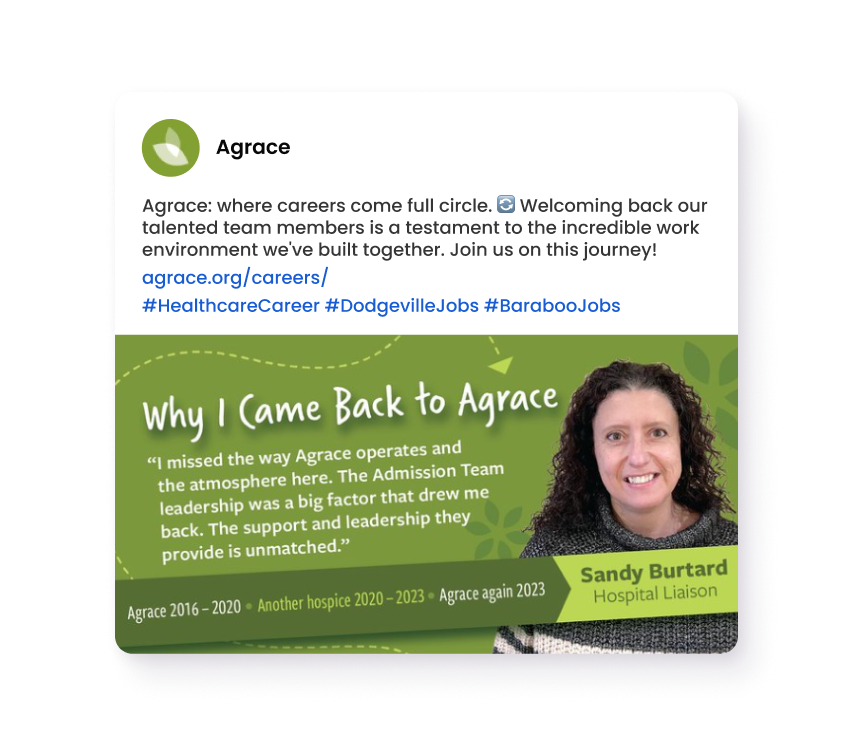
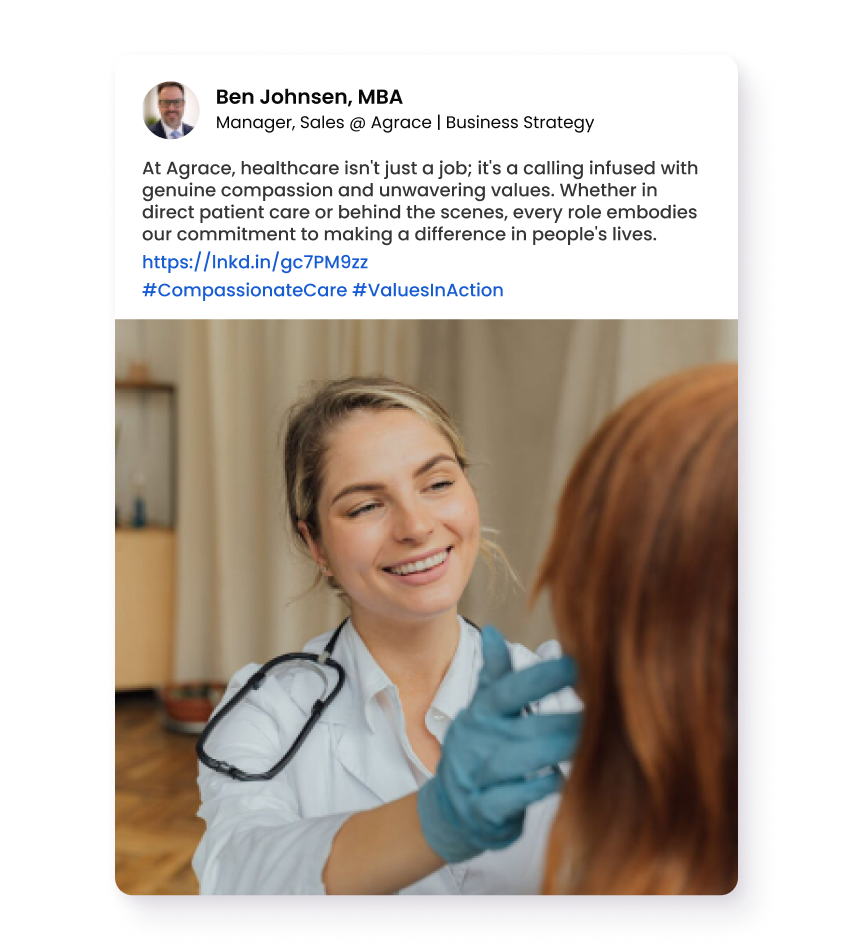
Agrace, a hospice and palliative care organization, doesn’t soften the emotional weight of their work. Instead, they lead with it, attracting candidates who want a calling rather than just a job and letting everyone else opt out early.
Company profile: Employee spotlights
Employee profile: Company values
Magellan Health
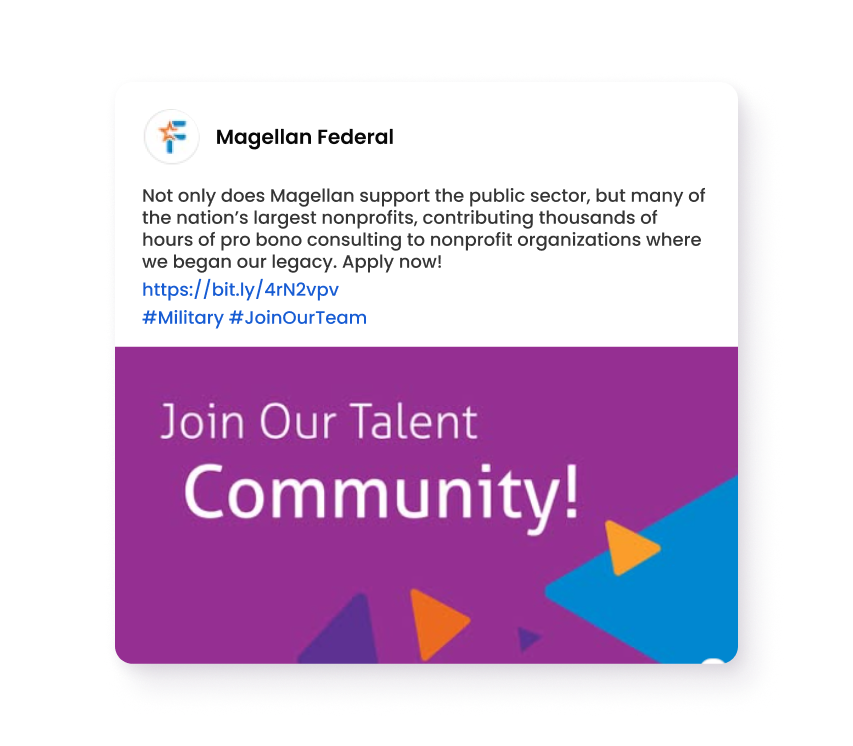
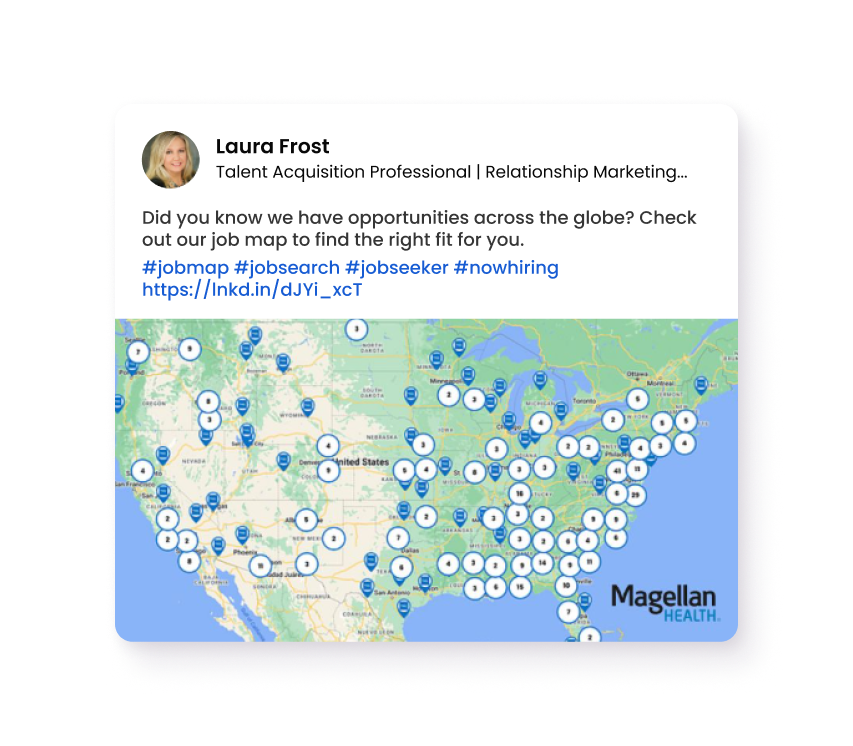
Magellan Health pairs company-level talent community campaigns with employee posts showing an interactive job map across global locations, keeping warm candidates engaged long before they’re ready to apply.
Company profile: Talent community
Employee profile: General hiring awareness
Aptiv
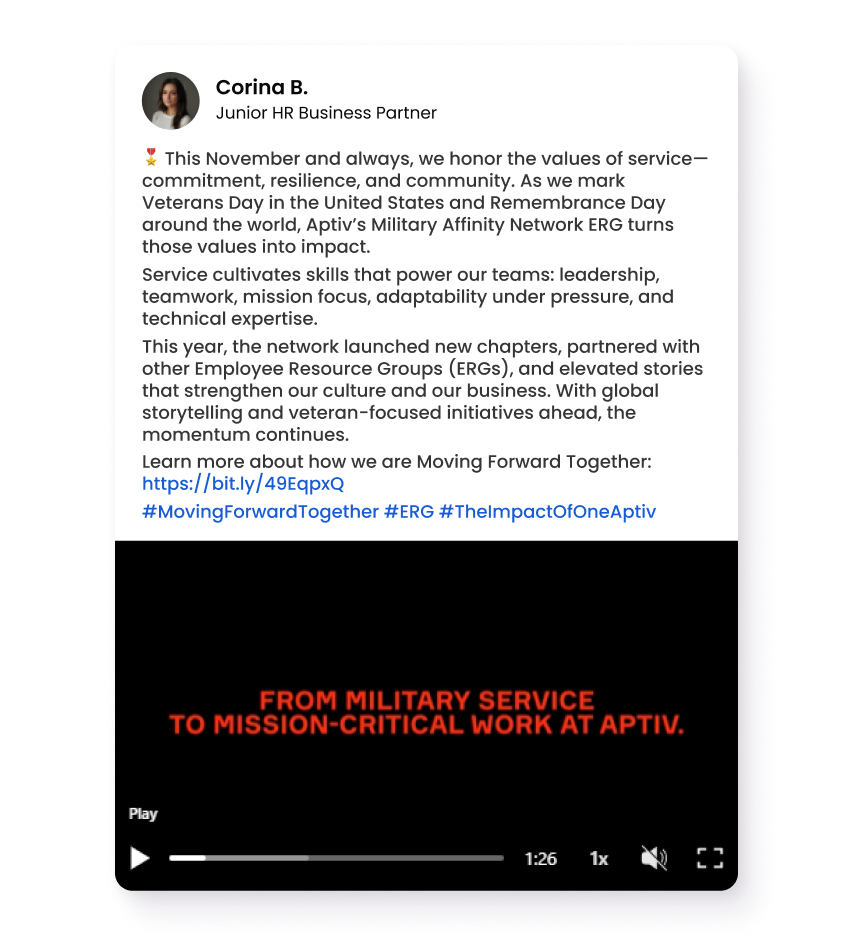
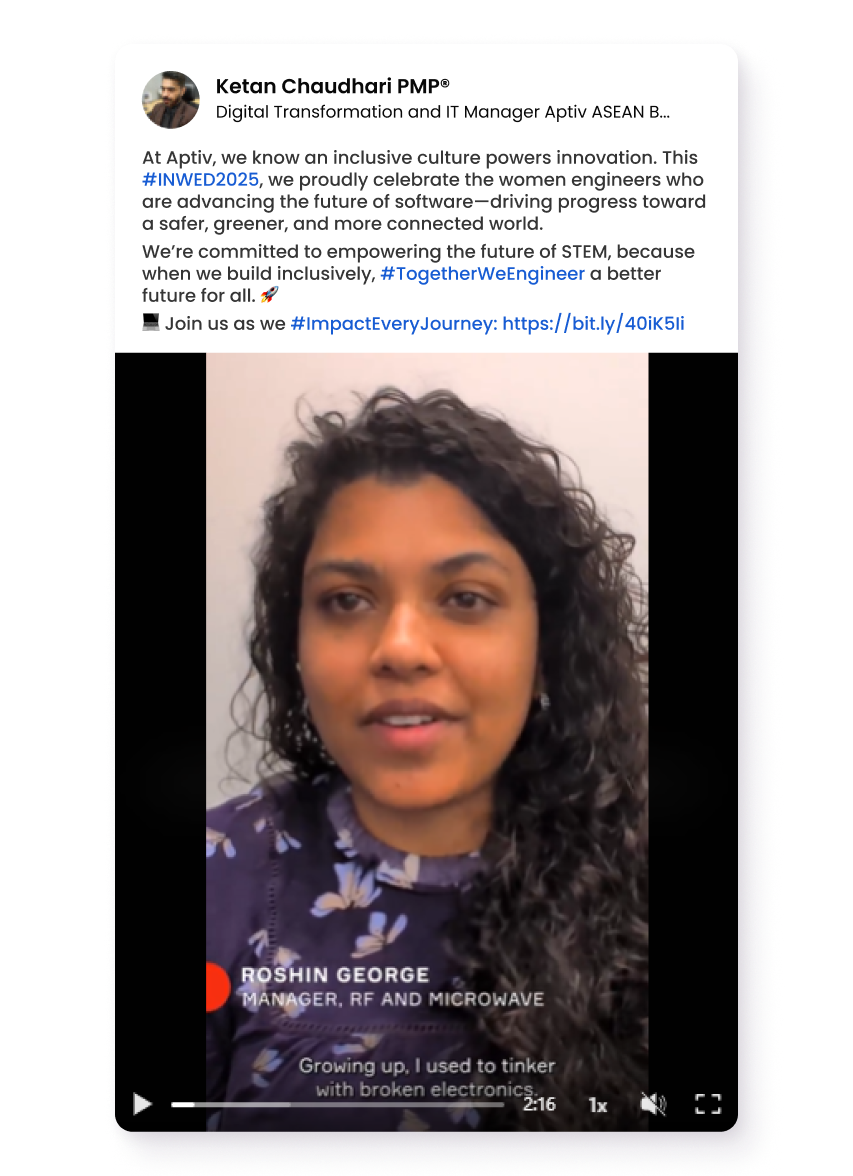
Aptiv runs region-specific content—tailored to EMEA, India, the US, Mexico, and more—deployed through local employee profiles, so each post reaches the right regional network through a voice candidates in that market actually trust.
Employee profile: US
Employee profile: India
While these companies represent different industries, different sizes, and different strategies, the thread running through all of them is the same: consistent, specific, people-first content that shows candidates exactly what they’re signing up for.
Common mistakes to avoid
Even companies with good intentions make these missteps. Here are a few things worth actively watching for.
Only posting when you have roles to fill
If the only time candidates hear from you is when you need something, you haven’t built a brand—you’ve just run a series of ads. Employer branding works because of consistent presence over time. Showing up only when you’re hiring sends a signal that you see candidates as a resource, not a relationship. Plus, social media platforms don’t reward that kind of inconsistency! You just can’t build your reach and authority without posting on a regular basis.
Creating content that sounds too polished or generic
“We’re a family here” and “passionate team of innovators” belong in the trash. (Sorry!) Candidates have read these phrases so many times they’ve lost all meaning—and worse, they signal that you’re not being specific or honest about what makes your company real. Authentic content that’s slightly imperfect is almost always more effective than polished content that could have come from anyone.
Forgetting employee perspectives
Your people are your most credible source of employer brand content. A quote from a real employee carries more trust than ten company-crafted posts. If your employer brand content consists entirely of graphics from the marketing team with zero employee voices, you’re leaving your most powerful asset on the table.
Neglecting measurement
What gets measured gets managed, and what doesn’t get measured quietly disappears when the budget conversation comes around. Even simple tracking—content engagement, application trends, Glassdoor score over time—gives you the data to defend the investment and make smarter decisions about what to do more of.
Waiting for a perfect framework
Finally, stop waiting. You don’t need a full brand book, a designed content library, or anything “official” before you start. Start with what’s true and available now. A post featuring a real team member talking about why they love their job is worth more than three months of planning for the perfect campaign. Get moving and refine as you go.
Final thoughts
Here’s the honest reality: your employer brand is already happening, with or without your active participation. Candidates are already Googling you, reading reviews, checking your LinkedIn, and forming opinions. The question is just whether you’re part of that conversation or not.
You don’t need a massive budget, a dedicated brand team, or a perfect framework to get started. You need stories, consistency, and a willingness to show up authentically over time. Start with what’s true, share it regularly, and let candidates see who you really are.
With a platform like HireSocial by CareerArc, you can stay consistent and organized—keeping your content aligned with what matters most to candidates without the manual effort that causes most employer brand programs to run out of steam.
Want to see how we help companies build and sustain a visible employer brand? Try HireSocial free for 30 days, or book a demo to check out the full suite of tools built for modern recruiting teams. We powered 1.4 million posts in 2025 for a reason!
Frequently Asked Questions
What is employer branding, and why does it matter?
Employer branding is how your company is perceived as a place to work by candidates, current employees, and former employees alike. It lives in your social media presence, your Glassdoor reviews, your career site, your job descriptions, and what your people say when someone asks what it’s like to work there.
It matters because candidates are researching employers more thoroughly than ever before, and they’re forming opinions long before they ever click “Apply.” A strong employer brand gives you more qualified applicants, faster hiring, better retention, and less reliance on expensive paid channels.
How is employer branding different from recruiting marketing?
Recruitment marketing is the tactical side: the campaigns, ads, job postings, and outreach designed to fill specific roles. Employer branding is the broader, longer-term foundation those tactics sit on.
Think of employer branding as building the reputation, and recruitment marketing as activating it. You can run great recruitment marketing campaigns, but if the underlying brand is weak or inconsistent, you’re constantly starting from zero. Strong employer branding makes every piece of recruitment marketing more effective.
How much does employer branding cost?
It varies widely depending on your approach, but employer branding doesn’t have to be expensive to be effective. The highest-cost approaches involve large creative agencies, full brand campaigns, and dedicated headcount. But some of the most impactful employer brand content—employee spotlights, culture posts, behind-the-scenes moments—can be created on a shoestring budget.
Tools like HireSocial by CareerArc also make it easier to maintain consistent output without large team investments by automating content creation from your existing assets. Start lean, measure what works, and scale from there.
How long does it take to see results from employer branding?
The honest answer: it depends on your starting point and your consistency. Some metrics—like application volume from organic sources or engagement on social content—can start shifting within a few months of consistent effort. Others, like meaningful changes in Glassdoor ratings or significant reductions in time-to-fill, typically take six to twelve months or more to reflect real brand-building work.
The short answer, though: employer branding is a long game. Commit for the long haul and you’ll see the impact, we promise!
What kind of content performs best for employer branding?
Content that features real people and specific stories consistently outperforms polished, generic brand graphics. Employee spotlights, behind-the-scenes moments, candid team photos, and direct quotes from actual employees tend to drive the most engagement because candidates can tell the difference between a curated corporate image and something real.
The general rule: the more specific and human it is, the better it performs. “We’re hiring passionate people” typically performs poorly. “Here’s Sandy, who left and came back because the leadership here is unmatched,” typically performs very well.
How do we get employees to participate in employer branding?
Start by making it easy and low-pressure. Share pre-written posts or draft captions that employees can post as-is or personalize. Celebrate and amplify the employees who do share content—publicly recognizing participation creates social proof and encourages others.
Integrate it into onboarding so new employees know from day one that sharing their experience is welcomed. And make sure leadership is visibly participating too—it signals that this is a company priority, not just an HR project. P.S. Tools like HireSocial let you push content directly to employee and recruiter profiles with minimal friction, which dramatically increases participation rates!
What should we track to measure employer branding success?
A combination of content metrics, recruiting metrics, and brand perception indicators gives you the fullest picture. On the content side: engagement rate, reach, profile visits, and click-throughs to your career site. On the recruiting side: application volume from organic sources, time-to-fill, offer acceptance rate, and quality of hire over time. On brand perception: Glassdoor rating trends, Indeed reviews, and employee Net Promoter Score (eNPS) from internal surveys.
Don’t try to track everything at once—pick three to five metrics that matter most for your current goals and build from there.
Can employer branding work for small companies or teams with limited resources?
Absolutely, and in some ways, smaller companies have an advantage. They can be more specific, more personal, and more authentic than large enterprises with layers of approval processes. A single compelling employee story posted consistently can build real brand equity over time.
The key is focusing your limited resources on the channels where your candidates actually are (usually LinkedIn, and one or two others), creating a small library of reusable templates, and showing up regularly rather than sporadically. Consistency at modest volume beats occasional bursts of high-production content every time.